A new European Commission report on education investment highlights a reality that education trade unions across Europe have long stressed: competitive salaries alone are not enough to attract and retain teachers. Improving working conditions, reducing workload and stress, and ensuring teachers are valued by society are equally important to strengthening the profession.
Published on 1 September, the report Investing in Education 2026: Focus on the Teaching Profession examines education spending across Europe and explores the factors that make teaching a more attractive career. The publication comes at a crucial time, as many European countries continue to face teacher shortages, recruitment difficulties and retention challenges.
According to the report, EU countries allocated 4.8% of GDP and 9.7% of total public expenditure to education in 2024. While education investment has stabilised in recent years, it remains below its pre-pandemic share of public expenditure, despite growing demands on education systems and increasing competition for public funding.
The report confirms that staff costs, particularly teachers' salaries, account for the largest share of public education expenditure. However, it also reveals that teachers' pay continues to lag behind that of similarly educated workers in most European countries. On average, lower secondary teachers' statutory starting salaries represent only 58% of the earnings of workers with comparable qualifications, rising to 89% at the top of the salary scale. The report states:
"Teacher salaries, both in absolute terms and relative to those of other professions, play a significant role in the attractiveness of the teaching profession. Salaries can influence decisions to enter the teaching profession (Nagler, Piopiunik and West, 2020) as well as decisions to remain in teaching (e.g., Hendricks, 2014; Burge et al., 2021). The education sector competes with other professions to attract and retain high quality graduates. Thus, teacher salaries relative to those of occupations requiring similar levels of education18, as well as teachers’ expected future earnings, can shape decisions about the teaching career (e.g. Nagler, Piopiunik and West, 2020; Qin, 2020). All other things being equal, the higher teachers’ relative salaries, the more attractive the profession."
At the same time, the Commission's analysis shows that salary increases alone cannot solve the challenges facing the profession.
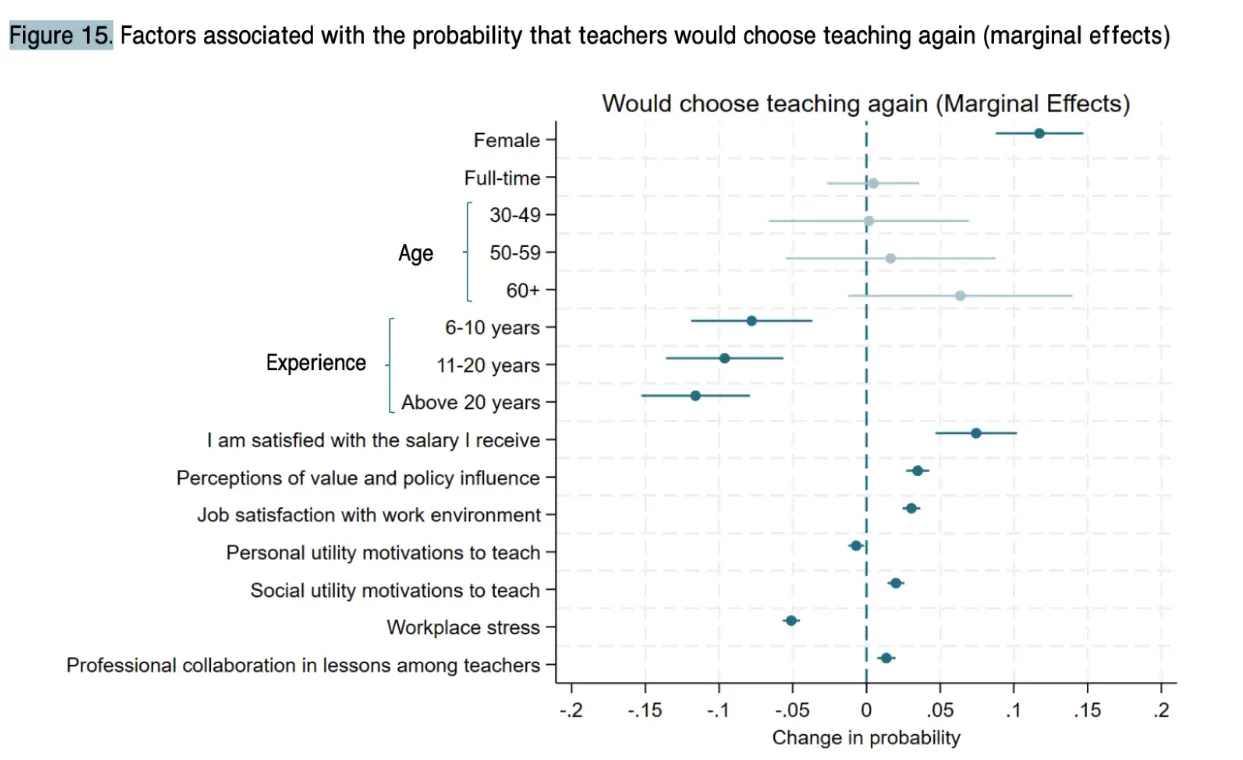
While teachers who are satisfied with their salaries are more likely to say they would choose the profession again, factors such as a supportive working environment, professional recognition, influence on education policy, and lower levels of workplace stress also have a significant impact on teachers' motivation and commitment. Workplace stress, in particular, was found to substantially reduce teachers' willingness to remain in the profession.
The findings draw on data from the OECD's TALIS 2024 survey and show that 76.5% of teachers would choose teaching again if given the opportunity, down from 79.2% in 2018. The decline is particularly noticeable among more experienced teachers, suggesting that retaining the existing workforce remains a major challenge.
Importantly, the report concludes that effective investment in the teaching profession requires a comprehensive approach combining competitive salaries with measures to improve teachers' well-being and working conditions. It argues that reducing excessive workload and stress while strengthening supportive school environments can play a key role in sustaining teachers' motivation and addressing teacher shortages.
These findings closely align with ETUCE's long-standing calls for governments and European institutions to invest not only in teacher pay, but also in decent working conditions, professional autonomy, continuous professional development and meaningful social dialogue.
The report should also be read alongside the recently published Eurydice study on teachers' and school heads' salaries and allowances in Europe, which highlights significant disparities in remuneration and career progression opportunities across European education systems.
The recently published The teaching profession in the EU A comparative analysis building upon the TALIS 2024 results from the European Commission offers a broader analysis on the attractiveness of the teaching profession, particularly highlighting the importance of professional autonomy and collaborative leadership. And also highlighting specific country recommendations for member states.
ETUCE welcomes these comprehensive reports by the European Commission. As the European Commission prepares its forthcoming EU Teachers and Trainers Agenda, ETUCE will continue advocating for policies that improve the attractiveness of the profession and ensure that every learner is supported by qualified, motivated and well-supported teachers.