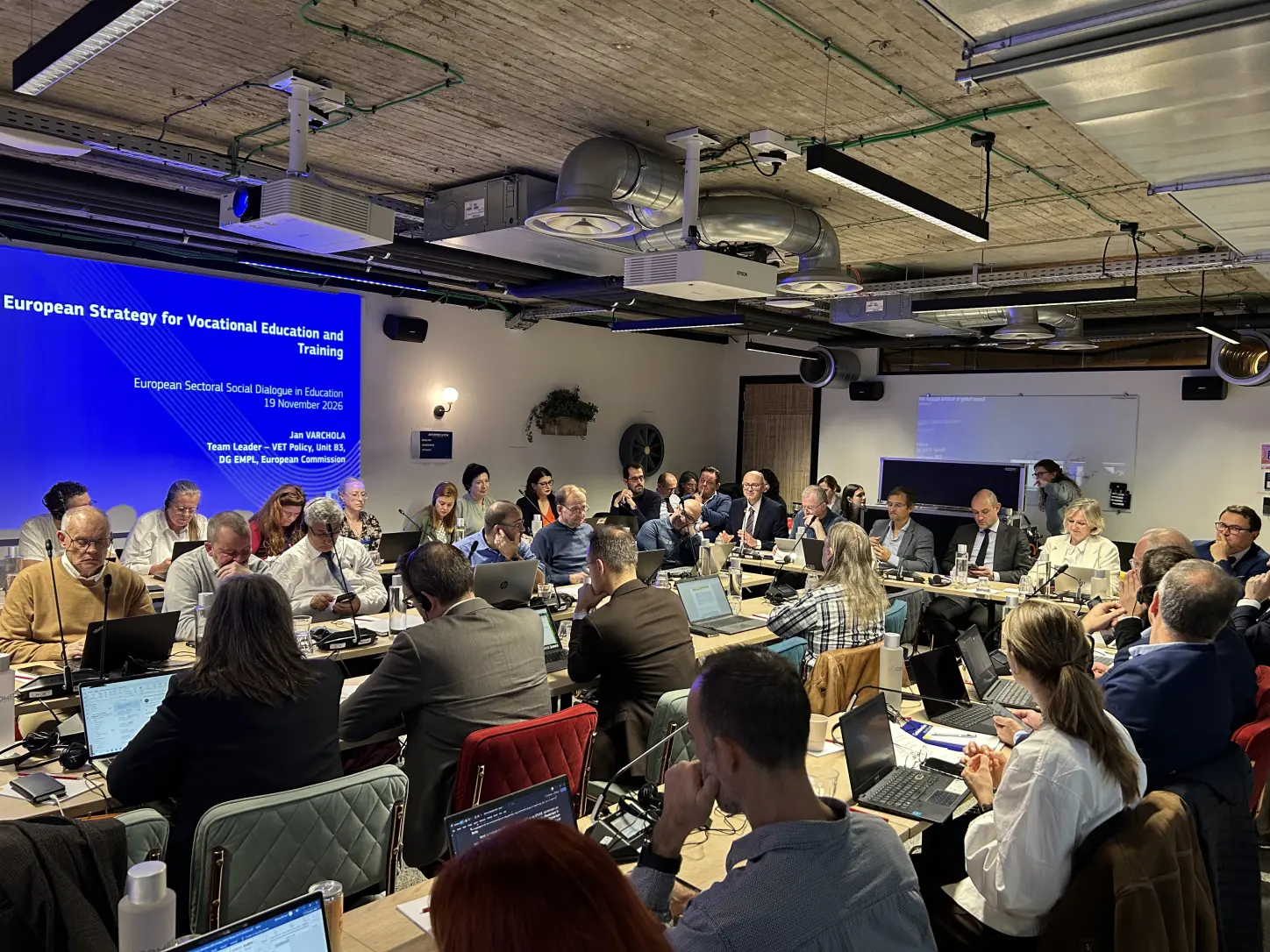
On 19 November, representatives of employers and trade unions in education gathered in Brussels for the plenary meeting of the European Sectoral Social Dialogue Committee for Education (ESSDE). The meeting provided the first opportunity for European education social partners to publicly discuss with the European Commission the recently published Education Package, just one day before the European Education Summit. The exchange offered an important occasion to share perspectives on the challenges facing education systems across Europe and to underline the importance of involving social partners in the design and implementation of education policies.
A key focus of the discussion was the European Commission’s new Education Package and its implications for learners, teachers, academics, researchers, education institutions and employers. ETUCE stressed that the success of future reforms will depend on meaningful social dialogue with those directly involved in education and training, as well as adequate investment and support for the education workforce.
The plenary meeting also marked an important milestone for the European social dialogue in education through the adoption of two major joint documents by ETUCE and EFEE.
The first, the ETUCE-EFEE Framework of Actions on Institutional Autonomy and Academic Freedom in Higher Education and Research, reaffirms the essential role of institutional autonomy and academic freedom in ensuring high-quality education and research, fostering innovation, and safeguarding democratic values. The framework sets out a series of actions aimed at supporting these principles and addressing emerging challenges affecting higher education and research institutions across Europe.
The second, the ESSDE Work Programme 2027–2029, establishes the priorities that will guide the work of the Committee over the next three years. The programme reflects the shared commitment of ETUCE and EFEE to addressing some of the most pressing challenges facing education across Europe. Over the next three years, the social partners will focus on strengthening teacher professionalism and supporting the development of basic skills and key competences, while also tackling issues that increasingly affect the attractiveness and sustainability of the profession, such as teachers’ working time, occupational health and safety, telework, and the right to disconnect. The programme also responds to broader developments shaping education systems, including digitalisation and artificial intelligence, the need for greater investment in quality education and training, the strengthening of social dialogue, and efforts to enhance preparedness and resilience in the face of future challenges.
The adoption of these two documents demonstrates the determination of European education social partners to continue working together on common priorities and to provide concrete responses to the challenges affecting education systems and the education workforce. Social dialogue remains central in shaping policies that support quality, inclusive and sustainable education.